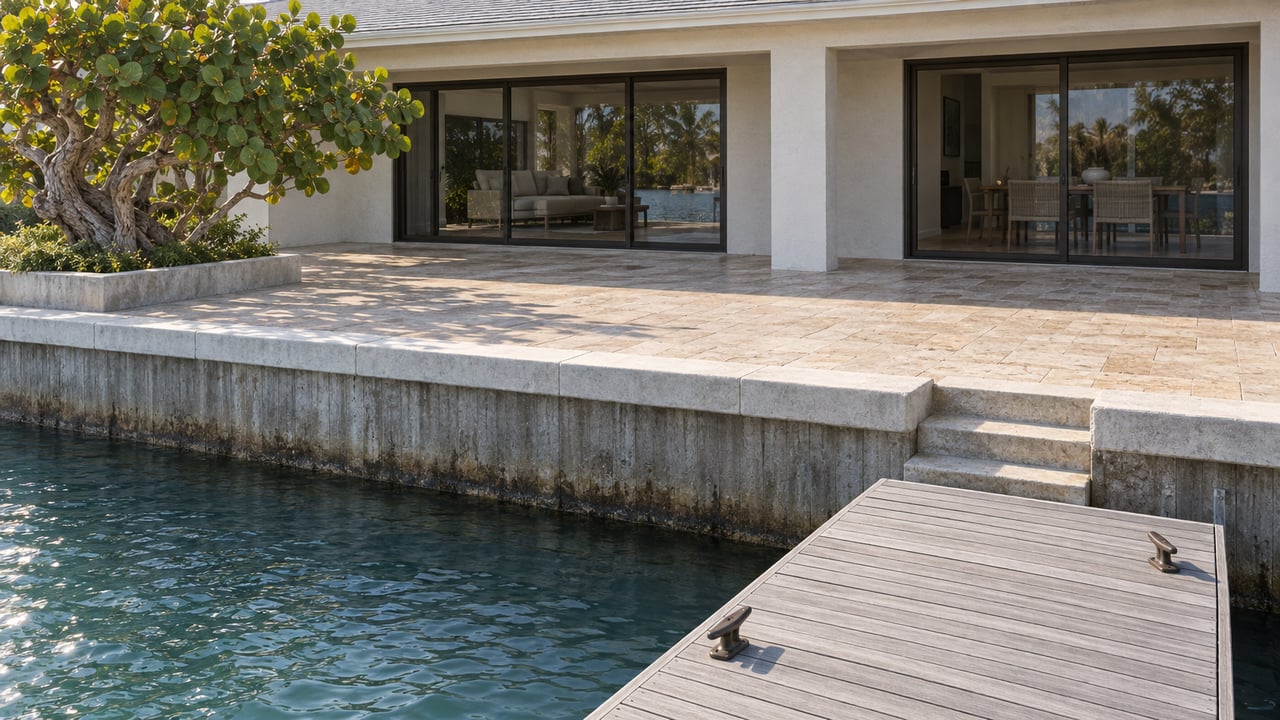
Englewood is one town split across two counties, Sarasota and Charlotte, and nowhere does that split matter more than at the water's edge. A canal home a few streets apart from another can face a completely different permitting process for the exact same project: same seawall, same dock, same boat lift, different rulebook. Buyers rarely ask which county governs the shoreline until they're already under contract. Sellers rarely think about it until a buyer's inspector asks for permit history they don't have.
That gap is where the friction lives.
The line you can't see from the street
Sarasota, Venice, and Wellen Park each sit inside a single county government. Englewood does not. Its waterfront runs along Lemon Bay and a network of canals that cross from Sarasota County into Charlotte County, and the property appraiser's parcel data, not the mailing address, is what actually determines which government reviews a permit application. A dock built on a canal in one jurisdiction follows Sarasota County's building and environmental review process. A dock built a short distance away, still with an Englewood address, may follow Charlotte County's building and zoning process instead. The county line doesn't show up in a drive-by showing. It shows up the day someone applies for a permit.
This matters because Englewood's waterfront neighborhoods, from Englewood Isles and Gulf Cove to Manasota Key, Grove City, Palm Grove, and Old Englewood Village, are not uniform in what regulators require or what the shoreline itself demands. Contractors working these canals generally treat the calmer, lower-energy canal systems as suited to lighter vinyl sheet pile seawalls, while the more exposed stretches along Manasota Key and similar open-water frontage call for heavier concrete construction built to handle direct saltwater exposure and storm surge. Add two different permitting authorities on top of that and the same-looking project can carry two very different timelines and costs depending on which side of an invisible line the parcel falls.
What actually differs, county to county
On the Sarasota County side, a standard seawall repair, one that involves replacing panels, tie-back rods, or cap sections, requires a county building permit, and a full seawall replacement on a typical 75-foot lot generally runs $300 to $800 in county permit fees plus an Environmental Permit Application review. The county's Natural Resources Department checks whether the work falls within 50 feet of wetlands, mangroves, or listed species habitat, which can trigger additional mitigation. Beyond the local permit, most canal work also needs a state or federal sign-off: the Florida Department of Environmental Protection issues a Letter of Authorization for projects that qualify as minor or exempt, and a standard residential dock or seawall repair on an artificial canal usually qualifies, which keeps the added timeline to roughly four to eight weeks. Add that federal layer and a straightforward dock with a boat lift typically moves from application to approval in eight to twelve weeks. A full seawall replacement that needs both county and FDEP review often takes three to five months from start to permit issuance.
On the Charlotte County side, the seawall permit process runs through the county's own Building Construction division rather than Sarasota County's Natural Resources Department, and it carries its own documentation list: a signed and sealed site plan, a Notice of Commencement recorded for any project with a contract price over $5,000, and confirmation that state or federal jurisdictional-water permits are in hand where applicable. Charlotte County also voids a permit if construction hasn't started within 180 days of issuance, or if it hasn't received an approved inspection within that same window, which is a detail worth knowing if you're buying a home where the seller pulled a permit and never finished the job.
| Sarasota County side | Charlotte County side | |
|---|---|---|
| Typical seawall permit fee | $300 to $800 | Set by county fee schedule; Notice of Commencement required over $5,000 |
| Standard dock and lift timeline | 4 to 8 additional weeks for FDEP review; 8 to 12 weeks total with an FDEP Letter of Authorization | Varies by scope; new site-plan requirement below adds a review step |
| Full seawall replacement timeline | 3 to 5 months with county and FDEP review | Governed by Charlotte County Code alongside DEP or Army Corps review where required |
| Local review layer | Sarasota County's Natural Resources Department reviews work near wetlands, mangroves, or listed species habitat | Storm-related residential permits can be filed at a pop-up office in Englewood itself |
A rule change effective October 1, 2026
Charlotte County is tightening its dock and boat lift application requirements starting October 1, 2026. From that date forward, every dock or boat lift application submitted to the county must include a survey, a site plan, or a hand-drawn site plan drawn to scale, showing all existing and proposed structures, applicable easements, and the Mean High-Water Line, Ordinary High-Water Line, or Average High-Water Line as it applies to the property. The application also has to show the distance from that water line to the proposed structure, and for developed properties, the distance from the existing house to the water line. Properties that already have a seawall need to show the distance from the seawall to the water line. Vacant lots need the distance from the edge of pavement to the water line.
None of that is paperwork for its own sake. A buyer closing on a canal home in late 2026 who plans to add a lift or rebuild a dock will need that survey-grade documentation in hand before submitting, and a seller who assumed an old survey would cover it may find the application bounced back for missing dimensions. Charlotte County has separately changed how permit expiration dates are calculated as of July 1, 2026, another procedural shift that affects anyone inheriting a permit that was pulled months or years ago and never closed out.
Charlotte County has also opened a residential storm-related permitting location inside Englewood itself, at 6868 San Casa Drive, a shorter trip than the main building department office at 18400 Murdock Circle in Port Charlotte. That satellite office currently handles residential storm permits only, not commercial work, which is useful to know if a seawall or dock repair on your closing checklist is tied to prior storm damage.
The permit that outlives the seller
The detail that catches people off guard isn't the fee schedule. It's whether a permit was pulled but never finished. Remediating an unpermitted or unclosed marine structure can run past $15,000 once permitting, engineering, and compliance costs are added up.
That risk sits quietly behind a lot of Englewood waterfront listings, because a general home inspection is built to evaluate the house, not the shoreline. A seawall can look fine from the yard while showing real deterioration below the waterline, and the standard inspection contingency most buyers rely on wasn't written with dock permit history in mind.
What to confirm before you write or accept an offer
- Pull the parcel record to confirm whether the property sits in Sarasota County or Charlotte County jurisdiction. The county line does not track cleanly with Englewood's mailing address.
- Request a permit history report for every waterfront structure on the property, including the dock, lift, seawall, and any decking or platforms, and confirm each permit shows a recorded final inspection.
- If a permit was pulled but never closed, treat that as a negotiating point before closing, not a surprise after.
- If you're planning any dock or lift work after closing on a Charlotte County parcel, budget time for the new survey and site plan requirement that takes effect October 1, 2026.
- Ask whether the seawall has had a dedicated marine inspection separate from the general home inspection, particularly on older canal-front homes where the wall's condition below the waterline is the part that's hardest to see from a showing.
A few questions we hear often
How do I find out which county actually governs my Englewood property? The property appraiser's parcel record, not the mailing address, determines jurisdiction. Sarasota County and Charlotte County both maintain online property search tools that show which government has authority over building and environmental permits for a given parcel.
Does a standard home inspection cover the seawall? Not fully. A general inspector may note visible concerns from the yard, but evaluating a seawall's condition below the waterline, including tie-backs, drainage, and soil loss behind the wall, typically calls for a separate marine inspection.
What if I'm selling, not buying? Pull your own permit history before listing. If a prior dock, lift, or seawall permit was never closed out, resolving it before you go under contract avoids a delay or price concession during the buyer's due diligence period.
If you're weighing a canal-front purchase or preparing to list a waterfront home in Englewood, Stone & Coast Realty Group can walk through the parcel's jurisdiction and permit history with you before you write or accept an offer.
This article is general information, not legal, tax or financial advice. Consult a qualified professional about your situation.