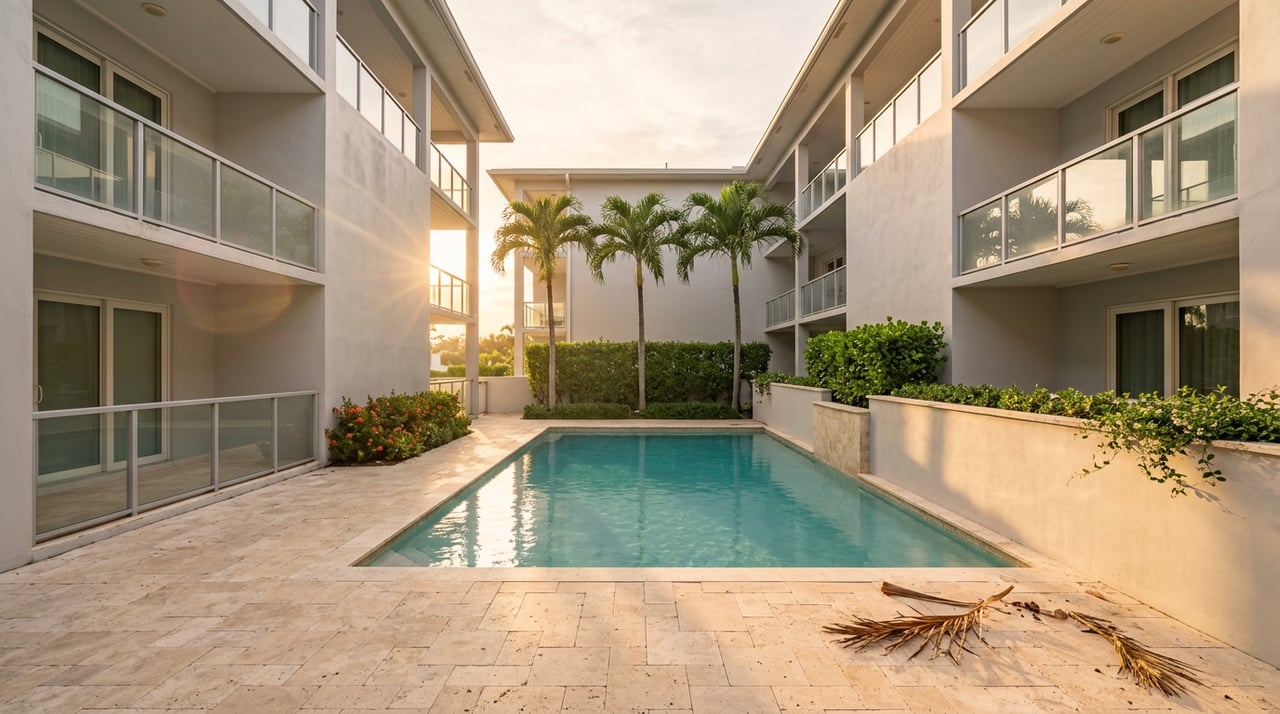
Three days before closing on a Longboat Key condo, a buyer's estoppel certificate came back with a number nobody had mentioned during the showing, the inspection, or the appraisal: a $15,000 special assessment, due at closing, for seawall repairs the association had already approved. The listing hadn't disclosed it. The agent hadn't known to ask early enough. The buyer had two options, both bad: bring an extra $15,000 to the table on short notice, or walk away from a deal that had already cost time, an inspection fee, and an appraisal.
That scenario is not rare in Sarasota right now, and it points to something buyers scrolling listings don't see: the price on the sheet and the price you actually pay can be two very different numbers, and the gap is decided by paperwork most people don't ask for until it's too late.
A number that shouldn't add up
Here's the piece of Sarasota's 2026 condo market that doesn't behave the way markets are supposed to. Active condo inventory across Sarasota County dropped to 2,870 units in June 2026, down from 3,955 a year earlier, a decline of more than 27 percent. Basic supply and demand says thinner inventory should support firmer prices. Instead, condo prices in the same market fell roughly 7.5 percent over the same period, with sellers closing around 92 percent of original list price and supply sitting at about 6.3 months, a buyer's market by most measures.
Fewer units, softer prices, longer runway to sell. That combination only makes sense once you know what's driving it. It isn't a lack of buyer interest in Sarasota condos. It's that a meaningful share of the existing inventory now carries compliance and assessment risk that wasn't priced into these buildings a few years ago, and the market is quietly sorting itself into buildings that have done the work and buildings that haven't. The list price doesn't show you which side of that line a given unit sits on. The reserve study does.
Why 2026 is the year this became unavoidable
Florida's post-Surfside reforms created two requirements for condo and cooperative buildings three stories or taller: a milestone structural inspection and a Structural Integrity Reserve Study, or SIRS. The SIRS prices out long-term costs for structural repairs.
The compliance clock on this has been moving for a few years, but 2026 is when the deferred bill actually came due. The Florida Department of Business and Professional Regulation says owner-controlled associations that existed before July 2022 were required to complete their initial SIRS by December 31, 2025, and associations that paired the SIRS with a milestone inspection got a coordinated extension to December 31, 2026. Either way, as of January 1, 2026, owners can no longer vote to waive or underfund reserves for those eight structural categories. That loophole, the one that let associations keep monthly dues artificially low for decades, is closed.
Industry estimates from earlier this year suggested more than half of eligible Florida condos still hadn't completed their SIRS. That's not a footnote. If a building missed the deadline, it's a visible signal of where else the association may be behind, and it belongs on a buyer's checklist before an offer, not during due diligence.
| Milestone | Deadline |
|---|---|
| Initial SIRS for owner-controlled associations existing before July 2022 | December 31, 2025 |
| SIRS coordinated with a milestone inspection | December 31, 2026 |
| Mandatory, non-waivable reserve funding for the 8 structural components begins | January 1, 2026 |
| According to SavingAdvice, HB 1021 requires an online disclosure portal for associations with 25+ units. | January 1, 2026 |
| According to NFM Lending, Fannie Mae and Freddie Mac retired Limited/Streamlined Review for projects over 10 units, requiring Full Review. | August 3, 2026 |
What to actually request before you write the offer
The building's compliance status isn't something a buyer discovers by asking "what are the HOA fees." It's found in a specific stack of paperwork. Before signing, ask for:
- The most recent SIRS, including the funding plan
- The two most recent annual budgets and reserve schedules
- Two years of association meeting minutes, where reserve transfers, special assessments, and waivers get recorded
- The current insurance declarations, both wind and flood
That fourth item matters more than it sounds. Insurance has become one of the biggest levers on Sarasota condo budgets, and a renewal that comes in well above what an association projected can trigger an assessment on its own, separate from any structural issue.
One structural engineer who inspects Florida buildings, quoted in a GoverningDocs report, explained why tile flooring on balconies and walkways draws extra scrutiny during milestone inspections: "Tile hides damage. We want to see it." A building that has stripped tile and applied protective coatings ahead of an inspection is signaling it's managing this proactively. A building that hasn't is asking a buyer to take more on faith.
The estoppel certificate and assessment responsibility
Even a buyer who does all of the above can still get surprised, because of timing.
This is what makes the estoppel certificate, ordered near the end of a transaction, one of the most consequential documents in a Florida condo purchase.
Financing tightened again this summer
Buyers who assume a healthy down payment insulates them from all of this got a reminder this summer. As of August 3, 2026, Fannie Mae retired its Limited Review option and Freddie Mac retired Streamlined Review for condo projects with more than 10 units, making Full Review the standard regardless of down payment size. In practice, that means the association's financials get scrutinized on nearly every conventional loan now, not just low down payment ones.
A building that hasn't completed its SIRS, or that fails the reserve tests lenders are now applying more consistently, can be classified non-warrantable. Conventional financing becomes difficult or impossible, which shrinks the buyer pool for that unit down to cash buyers. If you're planning to hold for five years or less, that's not an abstract risk. It's a number that belongs in your offer price today, because it will be someone else's problem when you go to sell.
What this looks like by submarket
The compliance picture isn't uniform across Sarasota, which is part of why a single median price tells you so little.
In The Meadows, a condo-heavy community in northeast Sarasota, associations sit at genuinely different points in the compliance cycle, some well-managed for years, others only now completing studies under the mandate. Two units at similar prices in adjacent buildings there can carry very different reserve profiles, and that difference doesn't show up in the listing.
Palmer Ranch has seen special assessments push some monthly obligations well past $850 after underfunded reserves forced emergency repairs, a jump that changes the real cost of ownership more than any renovation would.
Siesta Key and other coastal buildings in and around 34236 see assessments more often than inland stock, largely because salt exposure and storm wear show up repeatedly in milestone findings on roofs, balconies, and seawalls. Longboat Key's Gulf-facing towers carry the same exposure, plus the concrete spalling that shows up on facades closest to the water.
Downtown, along Palm Avenue and Ringling Boulevard, and in buildings like 100 Central, this is mostly a resale story rather than a new-construction one. Newer luxury deliveries such as the Ritz-Carlton Residences at The Quay, One Park at The Quay, and the Waldorf Astoria Residences at Five Points are also part of the downtown market.
None of this means avoid Sarasota condos. It means the buildings that have already done the work, current SIRS, funded reserves, no pending assessment, are a different and often better financial proposition than a similarly priced unit that hasn't, even when the listing photos look identical. And if you already own in a building that's compliant, that paperwork is a selling point worth using, not a technicality to bury in a drawer.
A few questions we hear often
Does any of this apply to villas or single-family homes? Check the property's compliance status before you buy.
The listing says "no assessments." Can I trust that? Treat it as a starting point, not an answer. Check the estoppel certificate and recent board minutes for assessment information.
What if a special assessment gets approved after I'm under contract but before closing? Under Florida Statute 718, whoever owns the unit when the assessment is levied owes it. That's why timing matters and why it's worth negotiating, in writing, who covers an assessment that lands during your contract period.
Are the new downtown towers exempt from all of this? The HOA Guide says the SIRS requirement is triggered by building height, not age, so even a tower delivered in 2026 needs a SIRS on file. The milestone inspection's age trigger, 30 years generally or 25 years within three miles of the coast, won't apply to new construction for decades.
If you're weighing a Sarasota condo purchase, or you own one and want to understand where your building stands before you list it, Stone & Coast Realty Group can walk through the SIRS, the reserve funding, and the timing questions with you before you're under contract, not after. Search Homes to see what's currently available across Sarasota's condo submarkets, or reach out directly to talk through a specific building.
This article is general information, not legal, tax or financial advice. Consult a qualified professional about your situation.